






There's a reason why properties have high yields! How to identify them and avoid failure in Sapporo real estate investment
2026.04.08
Table of Contents
- Introduction | Can You Really Trust That Yield?
- The Essence of Yield: The Numbers You See Are Only Part of the Story
- Why High-Yield Properties Sell | The Reality Behind the Numbers
- Key Points Beginners Often Overlook in Investing | The Structure Behind Misjudgments
- The perspective you really need to see | What lies beyond yield
- Summary: Discernment and decision-making, both are needed.
Introduction | Can You Really Trust That Yield?
When you start looking for properties with an interest in "Sapporo real estate investment" or "Hokkaido real estate investment," you'll inevitably come across high-yield investment properties. Some of these "Sapporo income-generating properties" even boast yields exceeding 10%, and at first glance, the numbers alone appear very attractive.
It's natural for those who are about to start real estate investing to think that high returns equal profit. However, in reality, properties with higher returns require more careful consideration. This is because there's always a reason behind that number, and in many cases, it involves some form of risk.
This article explains the mechanism and background of high-yield properties, and the decision-making criteria for beginners, based on the premise of the "Sapporo Real Estate" market.
The Essence of Yield: The Numbers You See Are Only Part of the Story
When considering "Sapporo commercial real estate" or "Sapporo income-generating properties," many people first compare the yields. While this is not wrong as an entry point for investment decisions, the problem lies in making a judgment without understanding what goes into it.
Generally, the yield presented in advertisements is the gross yield, calculated by dividing annual rental income by the property price. This figure does not include management fees, repair costs, property taxes, or even income reduction due to vacancies. In other words, there is a possibility of a significant discrepancy from the actual net profit.
For example, it's not uncommon for high-yield properties often seen in searches like "Sapporo real estate investment" to not generate as much cash flow as expected when actually managed. This is because hidden costs and risks are not factored in.
The yield is just a guideline, and it's fundamentally important to understand the underlying financial structure.
Why High-Yield Properties Sell | The Reality Behind the Numbers
In the Hokkaido real estate investment market, a certain number of high-yield properties do exist. However, without understanding why they are being sold at high yields, it is impossible to make a correct decision.
First, a major factor to consider is the high risk of vacancies. Even within Sapporo, demand varies greatly depending on the area. While stable demand can be expected in the central part of the city or along subway lines, there are cases where it can be difficult to find tenants in suburban areas or locations with poor convenience. Properties like these often show higher gross yields by lowering rent, and it's necessary to consider that they may not be able to maintain full occupancy in reality.
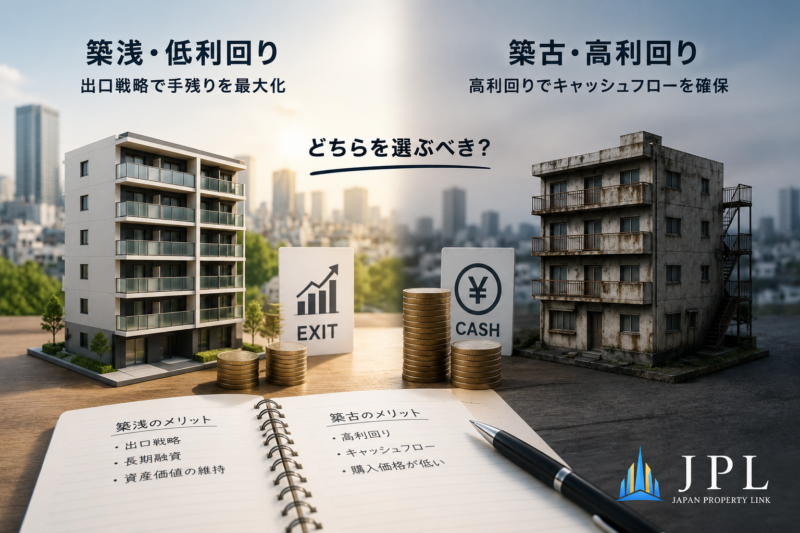
Next, the age of the building is also a point that cannot be overlooked. Among "Sapporo rental properties," properties over 30 years old tend to decrease in price, and as a result, their yields tend to appear higher. However, older properties come with repair risks. Significant costs may arise in unseen areas such as exterior walls, roofs, and water supply and drainage systems, and in some cases, funds may be needed immediately after purchase.
Furthermore, a weak location is another factor contributing to high yields. While properties in Sapporo might be broadly categorized as "Sapporo real estate," the characteristics of each area differ significantly. In areas with weak demand, prices fall, leading to higher yields, but this also increases the difficulty of rental property management. Since location is an element that cannot be changed later, neglecting this point can lead to long-term struggles.
There are also cases where the rent level itself is problematic. If the assumed rent at the time of sale is set higher than the market rate, or if it's based on data from when the property was fully occupied in the past, the finances can crumble when rents decline after purchase. For "Sapporo real estate investment," it is crucial to always confirm the current market rent and make decisions based on realistic financial projections.
Key Points Beginners Often Overlook in Investing | The Structure Behind Misjudgments
A common pitfall for real estate investment beginners considering "Sapporo commercial properties" or "Sapporo income properties" is being swayed by high yields. Because the numbers are easy to understand, there's a tendency to compare and judge solely based on them.
However, what is important in actual investment is not the yield itself, but the assumptions under which that yield is generated. For example, the meaning of a yield calculated assuming full occupancy is completely different from a yield that incorporates a certain vacancy rate.
Additionally, there are cases where people become complacent simply because the price is low. While there are many properties in the lower price range within "Hokkaido real estate investment," giving the impression that they are affordable, a low price may also indicate low market value. This can ultimately make it difficult to sell and affect your exit strategy.
Simply accepting the sales representative's explanation can also be a factor that increases risk. Instead of making decisions solely based on phrases like "will be filled soon" or "popular area," you need to adopt an attitude of checking the data yourself. In the "Sapporo Real Estate" market, due to significant information asymmetry, proactive decision-making is extremely important.
The perspective you really need to see | What lies beyond yield
To achieve stable results in "Sapporo real estate investment," having perspectives beyond just yield is essential. What's important is whether the property is structured to generate income long-term.
The first thing to note is the stability of demand. It is necessary to determine if there is continuous rental demand in the area, considering factors such as demographics, the surrounding environment, and transportation convenience. Among "Sapporo rental properties," stable properties are always supported by a certain level of demand.
Next is the financial realism. It's important to check if it's feasible by factoring in vacancies and repairs, rather than an optimistic simulation. Focusing on long-term cash flow, rather than short-term yields, allows for more sound judgment.
Additionally, an exit strategy is essential. For "Sapporo commercial real estate," not only the purchase market but also the sales market is important. By understanding in advance what kind of buyers can be anticipated in the future and whether the property is circulating within that price range, risks can be significantly reduced.
Summary: Discernment and decision-making, both are needed.
In the "Sapporo Real Estate" market and also in "Hokkaido Real Estate Investment," high-yield properties do exist and are indeed attractive. However, purchasing them without understanding the reasons for their high yields turns investment into speculation.
It is important not to be swayed by the figure of the yield, but to correctly grasp the risks and assumptions behind it. By comprehensively assessing factors such as vacancies, repairs, location, and rent, and accurately determining realistic income and expenses, you can avoid unnecessary failures.
On the other hand, if you become overly cautious by focusing too much on these factors, you may miss out on excellent "Sapporo income properties" or "Sapporo commercial properties" that you should otherwise acquire. Real estate investment is also heavily influenced by timing, and properties with favorable conditions do not remain on the market for long. It is not uncommon to miss out on opportunities simply by taking too long to make a decision.
That's why, in the end, you need to make decisions with an understanding of the risks and, at times, a willingness to be bold. Rather than waiting to understand everything perfectly, it's important in the investment world to make decisions based on certain criteria.
Rather than making that decision alone, proceeding with a partner who understands the market will improve investment accuracy. We offer a perspective that can only be provided by someone who is familiar with the “Sapporo real estate investment” landscape and has seen numerous “Hokkaido real estate investment” opportunities. Identifying risks that cannot be seen from numbers alone, and conversely, discerning value that does not appear in numbers, leads to stable investment.
The ability to assess risk and the judgment to take the leap. We are here to support both.

Representative director
Success in real estate investment is not achieved by luck or coincidence. I believe that every encounter, decision, and outcome is inevitable for a reason. That's why I take responsibility for each and every project and believe in finding the best path forward with reliable information and strategy.