


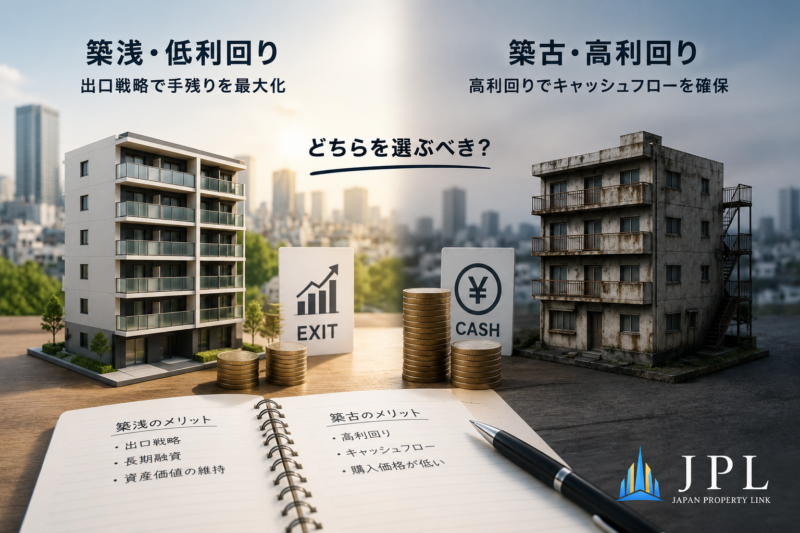





Aiming for capital gains? Or income? - The “Essence of Real Estate Investment” That Such Arguments Alone Can't Reveal”
2026.05.18


When it comes to real estate investment, the topic that almost always comes up is
Are you aiming for capital gains?
Are you aiming for income?
is the word.
Are you aiming for capital gains?
Should I accumulate monthly rental income?
Real estate investing is a world that is often discussed in these two [options/alternatives].
Of course, this way of thinking itself is not wrong.
However, if you've been in the real estate industry for a long time, you'll realize that there are many investors who cannot be explained by these two options alone.
Rather, the people who are truly building wealth,
I am a Capitalist.
I'm a dividend investor.
And, I get the impression that it's not divided that simply.
This time, we will write about “capital” and "income" in real estate investment, as well as a "third perspective" that many people tend to overlook.
Table of Contents
What is capital gain?
Simply put, capital gains are "profit from selling."
For example, if you buy a property for 100 million yen and sell it for 120 million yen, the difference of 20 million yen is your profit.
In central city condominium units, redevelopment areas, and areas with strong land values, there is a trend of many investors targeting capital gains.
Especially recently,
Hold for a few years and sell at a profit.
Take profits at the exit
This way of thinking has become widespread.
During favorable market conditions, it is possible to grow your assets significantly in a short period, and the speed of expansion when utilizing leverage is also very fast.
Of course, this is by no means a bad thing.
On the other hand, aiming for capital gains has an “market-dependent” aspect.
The selling price is something I cannot control.
Exit prices fluctuate due to various factors such as interest rate conditions, lending situations, market environments, economic conditions, and foreign capital.
In other words, there is always a possibility that you won't make the expected profit.
Furthermore, capital gains target the characteristic of "profit being realized only upon sale."
As long as there are unrealized gains, they are merely “paper profits.”
It is not finalized until it is actually sold and converted to cash.
That's why investors who think about their exit strategy are very careful when looking at properties from the very beginning of their purchase.
Not just "where to buy," but
Who will buy next?
Will banks be able to lend in the future?
Will demand remain even when the market cools down?
In many cases, they are calculating backwards from there.
Income gain
In contrast, income gain is the concept of accumulating rental income.
Deduct loan payments and expenses from the monthly rent and build up cash flow.
This is an investment that emphasizes what is called "monthly leftover money."
This idea becomes stronger with local high-yield properties and whole apartment investments.
The appeal of prioritizing income is, after all, its stability.
Having a fixed income every month makes it less susceptible to market fluctuations.
The feeling of rental income accumulating beyond your main job is one of the unique appeals of real estate investment.
Actually, the reasons for starting real estate investment include
I want to increase my monthly income.
I want to create income sources outside of my company in the future.
Many people hold this idea.
In particular, Japan is an era where many people feel anxiety about the future.
The ability to create income that doesn't solely rely on salary is a major strength of real estate investment.
However, there are pitfalls here too.
There are many properties that appear to have high yields but actually have significant repair risks, high vacancy rates, or weak exit strategies.
Even if you have positive monthly cash flow, there are cases where asset value can significantly decline in the long term.
Especially with older, high-yield properties,
"You get rent income, but there's almost no residual building value left in the end."
This is not an uncommon case.
In other words, just looking at income alone may not lead to substantial asset building.
What many investors overlook
Here's the main topic.
Real estate investment is often discussed as a binary choice between "capital or income," but in reality, there's another important perspective.
That's why
What remains after full repayment
That's the way of thinking.
For example, let's say you purchased a property with a 35-year loan term.
The initial cash flow is not that strong.
It's not the type that generates large capital gains in the short term.
At first glance, it may seem like a half-baked property.
However, the situation will change significantly when the loan is paid off in 35 years.
Of course, the repayment will be zero.
In other words, the money that was previously used for repayment will remain as profit.
More importantly,
The tenant is repaying the loan.
is the point.
Repayments are made with rental income, and ultimately only assets remain.
I feel this is one of the essences of real estate investment.
This is also a big difference from stock investing.
Stocks are an investment where you buy with your own money and wait for them to increase in value.
Meanwhile, real estate can be financed by financial institutions, with loan repayments made through rental income.
In other words, it can be said that it is an investment that allows you to build assets while utilizing "other people's capital" and "time."
That's why, in real estate investment, judging solely by short-term income and expenses can cause you to lose sight of the essence of the matter.
Judging solely by "how much is left" can be dangerous.
Lately, on social media as well,
"Monthly cash flow of XX million yen"
Yield of X%
There have been many such stories.
Of course, it is an important indicator.
However, if you make investment decisions based solely on that, you may miss out on significant opportunities for wealth creation that you would otherwise have had.
For example, imagine a scenario with an older property in a provincial area offering high yields and a monthly cash flow of 150,000 yen, versus a newer property in a prime urban location with only 20,000 yen remaining monthly.
In the short term, the former might seem more appealing.
However, if you consider it to include the next 20 years, the situation changes.
When you include asset value, salability, loan continuity, and even the profitability that arises after full repayment, there are cases where the results are reversed.
Conversely, the result of chasing only high yields,
I had money left over each month, but in the end, next to nothing remained.
These kinds of stories are not uncommon.
So, real estate investment is
"How much is left now?"
not only
What will be left in the end?
This means that we need to think about it.
Truly strong investors think in terms of “balance.”
In reality, the investors who survive for a long time are not extreme.
Look at the cash flow as well.
Look at the exit too.
You also look at asset value.
I'll also look at the financing terms.
And on top of that,
What will this property ultimately be as an asset?
I am thinking about
Because real estate investing is not a sprint, it's a marathon.
Chasing short-term profits too much can lead to stagnation in lending or an inability to accumulate assets.
Conversely, if you focus too much on asset value alone, your cash flow will become strained.
Also, real estate investment isn't a one-and-done kind of thing.
As you continue to purchase a second, then a third property, relationships with financial institutions, the trend of available funds, and the balance of your owned properties also become important.
At that time, portfolios that only pursue short-term profits can be surprisingly fragile.
That's why what's important is
Capital
Income
Remaining assets after full repayment
I think it's about how to design these three.
Real estate investment is “wealth building.”
When you first start real estate investing, you can't help but focus on your monthly income and expenses.
Of course, that's natural.
However, as I gain more experience,
How much assets will be left in the end?
Many investors realize the importance of this perspective.
Real estate investing is
It's also a game of "how much is left now,"
It's also a game of designing "what remains in the end."
Leverage the power of time, utilize other people's capital, and ultimately build your assets.
That's one of the essences of real estate investment, isn't it?
That's why,
"Capital?"
"Is that income?"
not just these two options
What do you want to leave behind at the end?
I think it's very important to have that perspective.
In 10 years, 20 years, and 30 years,
What assets would you like to keep?

Representative director
Success in real estate investment is not achieved by luck or coincidence. I believe that every encounter, decision, and outcome is inevitable for a reason. That's why I take responsibility for each and every project and believe in finding the best path forward with reliable information and strategy.