


“Sapporo is safe” no longer applies. The “winning areas” and "assets that will remain" for real estate investment in Sapporo, as understood from demographic trends.”
2026.05.11
Sapporo is one of the cities that is attracting a lot of attention from real estate investors nationwide.
Compared to central Tokyo, property prices are more affordable, and considering Sapporo's population size and urban functions as a government-designated city, many investors think, "Start with a building in Sapporo."
In recent years, voices viewing the Sapporo real estate market positively have continued to increase, due to factors such as redevelopment around Sapporo Station, the recovery of inbound demand, and anticipation of semiconductor-related investments across Hokkaido.
In fact, looking at the nation as a whole, Sapporo remains an attractive market.
However, one thing to note here is making investment decisions solely based on the broad category of "Sapporo City."
The era of real estate investment is entering a stage where results will vary greatly depending not on whether it's in Sapporo, but on *where* in Sapporo you own property.
Even within Sapporo city, some wards are experiencing population growth, while others have already entered a phase of decline.
Looking closely at factors such as the ratio of the working-age population, the aging rate, transportation convenience, and the presence or absence of redevelopment reveals that the difference between "cities that will continue to attract people" and "cities that will gradually become less desirable" is greater than imagined.
Real estate may seem like you're buying a building, but in reality, you're buying “people flow.”
That's why looking at demographics is extremely important.
This time, based on Sapporo city's population statistics and the characteristics of each ward, we will organize "where value will remain in Sapporo real estate investment from now on" from an investor's perspective.
Table of Contents
- Chuo Ward | An Area Chosen for “Asset Value” Over “Yield”
- North Ward: The large “area differences” that cannot be seen by simply looking at "largest population"
- West Ward | Not a city to live in because it's cheap, but a city chosen because it's easy to live in“
- Toyohira Ward | It's not flashy, but it has the strength of being “hard to collapse.”
- Shiroishi Ward | An Area Consistently Chosen for its Balance of “Price and Convenience”
- Atsubetsu Ward | How to View the “Shin-Sapporo Redevelopment”
- Teine Ward | Don't overlook the “exit” behind high yields
- Kiyota Ward / Minami Ward | Towards an Era of Looking at “Future Demand” Rather Than "Current Revenue"
- Future real estate investment in Sapporo: How to create “residual assets”
Chuo Ward | An Area Chosen for “Asset Value” Over “Yield”
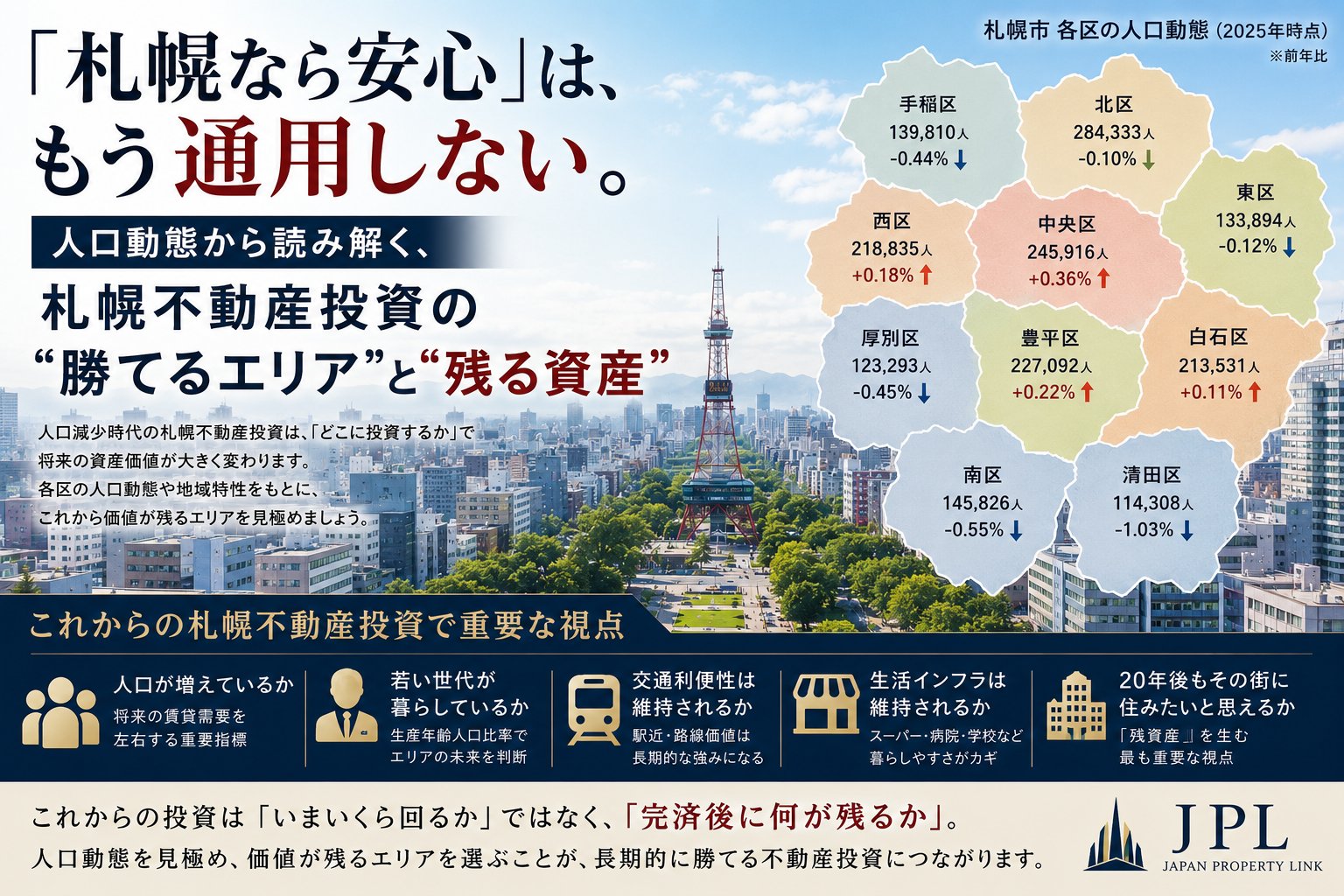
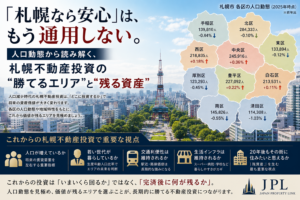
As of 2025, the population of Chuo Ward is 245,916. This represents a 0.36% increase compared to the previous year, indicating stable population growth within Sapporo City.
Furthermore, the working-age population ratio is at a high level of 65.8%.
What this number signifies is the continuous accumulation of "working-age people who pay rent."
In the rental market, the strength of this foundation is very important.
The reason Chuo Ward is strong is very simple.
Because the city's main functions are concentrated in Sapporo Station, Odori, and Susukino.
Business, commerce, tourism, administration, finance.
It has overwhelmingly the reasons people gather.
In an era of population decline, not everyone will live everywhere.
People tend to gather in convenient locations.
In that sense, Chuo Ward can be called the area in Sapporo that is most likely to attract demand.
Of course, the price is high.
Looking only at the gross yield, local properties with high yields might seem more attractive.
However, what's important for future real estate investment isn't just "how much it turns over right now."
It's about how much value remains after 20 and 30 years.
Chuo Ward's strength lies in the fact that “demand tends to remain even as properties age.”
Furthermore, liquidity and financial institution evaluations tend to be relatively well-maintained upon sale.
Perhaps Chuo Ward should be seen as an area for “preserving assets” rather than a place to "aim for high yields."
North Ward: The large “area differences” that cannot be seen by simply looking at "largest population"
Kita Ward has a population of 284,333, making it the largest ward in Sapporo City.
However, it decreased by 0.10% compared to the previous year.
The important point here is that "having a large population" and "having high future potential" are separate things.
When talking about Kita Ward, one cannot overlook the “large differences between areas.”
Areas along the Namboku Subway Line, such as Asabu, Kita-Nijuyojo, and Kita-Juhachijo, offer excellent access to the city center and have very strong demand from single individuals.
On the other hand, the situation changes in suburban residential areas.
This is because as the population continues to decrease, demand is likely to become increasingly concentrated in “convenient locations.”
So, even within the same Kita Ward, there will be a significant difference in future prospects between areas within walking distance of the subway and areas that rely on buses.
A key strength of Kita Ward that cannot be overlooked is the presence of Hokkaido University.
There are diverse rental needs, not only for students but also for researchers, university staff, and young single individuals.
In other words, Kita Ward is both a “student town” and a “residential area close to the city center.”
However, in the future, the idea of “safe because it's Kita Ward” will no longer be sufficient. Instead, the perspective of "where in Kita Ward will still be chosen in 20 years?" will become much more important.
West Ward | Not a city to live in because it's cheap, but a city chosen because it's easy to live in“
The population of the West District is 218,835, an increase of 0.18% compared to the previous year.
The working-age population ratio is 60.4%, which is a relatively stable level within Sapporo city.
The West Ward's strength lies more in its “ease of living” than in numbers.
Good access to the Tozai Subway Line and JR Hakodate Main Line, making it ideal for commuting to the city center.
In addition, living infrastructure such as commercial facilities, medical institutions, schools, and supermarkets is extremely well-developed.
The Kotoni area, in particular, can be said to be one of Sapporo's prime “cities with high convenience for daily living.”
The important thing here is that Nishi Ward is not a city chosen "because the rent is cheap."
“It's a city chosen because it's easy to live in.
In an era of declining population, this difference becomes very significant.
It is possible that in the future, there will be a stronger trend towards choosing "convenient locations even if the rent is a little higher."
In that sense, Nishi Ward has conditions that are likely to maintain demand in the long term.
Also, because prices have not surged as much as in Chuo Ward, it's an area where it's easier to balance “profitability” and “asset value.”
Of course, the West Ward is not a monolith.
There is a difference in demand between properties within walking distance of the subway and those on the mountain or suburban sides.
However, looking at it comprehensively, the Western District is "not flashy, but strong."
This is an area that feels very compatible with long-term holding.
Toyohira Ward | It's not flashy, but it has the strength of being “hard to collapse.”
The population of Toyohira Ward is 227,092, an increase of 0.22% compared to the previous year.
Furthermore, the working-age population ratio is high at 64.3%, with the working generation strongly supporting the region.
From an investor's perspective, Toyohira Ward is a “model student” type of area.
It offers high transportation convenience, primarily centered around the Higashi-Toyoh line of the subway, catering to a wide range of demands from single individuals to families.
Not being overly dependent on specific attributes is a major strength for long-term holding.
Furthermore, areas like Gakuenmae, Misono, and Tsukisamu offer excellent access to Chuo Ward and maintain stable popularity among owner-occupiers.
The good thing about Toyohira Ward is that it doesn't “collapse suddenly.”
In real estate investment, people tend to focus on areas with flashy growth.
But what's truly important is, “Will there still be demand in 20 years?”
In an era of population decline, there will be more and more situations where the value of "not collapsing significantly" will increase rather than "growing significantly."
In that sense, Toyohira Ward may be an area that is very compatible with “solid asset building.
Shiroishi Ward | An Area Consistently Chosen for its Balance of “Price and Convenience”
Shiroishi Ward's population is 213,531, an increase of 0.11% from the previous year.
Furthermore, the working-age population ratio is high at 64.4%, and the aging rate is relatively low.
In other words, it can be said that it is a town with a steady influx of people who will be paying rent from now on.
This area offers lower prices than Chuo Ward while still providing access to the Tozai Subway Line and JR lines, making it popular among investors.
It pairs particularly well with rentals for single occupants, tending to ensure a stable demand.
However, Shiroishi Ward is not a monolith.
The atmosphere of a city and rental demand change significantly between residential and industrial areas.
In recent years, prices have also been rising, and we are no longer in an era where you can "buy cheaply and get high yields."
That's why from now on, instead of “anywhere in Shiroishi Ward is fine,” “where in Shiroishi Ward to choose” will become even more important.
Atsubetsu Ward | How to View the “Shin-Sapporo Redevelopment”
Atsubetsu Ward has a population of 123,293, a decrease of 0.45% compared to the previous year.
The working-age population ratio is 56.5% and the aging rate is 34.4%. Looking at the numbers alone, it's not an area where you can be optimistic.
Still, there are reasons why investor attention has been increasing in recent years.
That's the “New Sapporo Redevelopment.”
Currently, large-scale development is underway in the Shin-Sapporo area, including commercial facilities, medical facilities, hotels, and condominiums.
Urban redevelopment isn't just about making the cityscape look better.
The flow of people may change, creating new demands in the city.
This means that the “real estate value itself” can also change.
Furthermore, Shin-Sapporo offers double access via JR and the Tozai Subway Line.
This has a certain strength even within Sapporo city.
However, the important point is that "Atsubetsu Ward as a whole is not strong."
There's a significant possibility of a widening gap between areas that benefit from redevelopment and those that don't.
Therefore, perhaps what to look for in Atsubetsu Ward isn't whether it's in Atsubetsu Ward, but rather its proximity to Shin-Sapporo.
Teine Ward | Don't overlook the “exit” behind high yields
The population of Teine Ward is 139,810, a decrease of 0.44% from the previous year.
The working-age population ratio is 55.4%, and the aging rate is 33.2%.
Teine Ward has relatively stable prices compared to other wards in Sapporo, and many high-yield properties can be found there.
Therefore, it may seem attractive at first glance.
However, in real estate investment, it is very important to consider “why the yield is high.”
High yields may also reflect factors such as vacancy risk, low liquidity, and population decline risk.
Of course, there are areas where a certain level of demand can be expected, such as around Teine Station.
However, compared to areas along the subway lines, the “distance from the city center” cannot be denied.
Additionally, many areas have a high dependence on cars, and are vulnerable to the future impacts of an aging population and population decline.
From now on, the tendency to live somewhere not because it's cheap, but because it's convenient, could become even stronger.
Thinking about it that way, it's dangerous to make investment decisions based solely on low prices.
Perhaps the most important thing to consider in Teine Ward isn't the “current yield,” but rather “will someone want that property in 20 years?”
Kiyota Ward / Minami Ward | Towards an Era of Looking at “Future Demand” Rather Than "Current Revenue"
Kiyota Ward decreased by 1.03% compared to the previous year, and Minami Ward also decreased by 0.55%.
Furthermore, Minami Ward has an elderly population rate exceeding 36%.
Of course, the prices are lower, and high-yield properties do exist.
However, real estate investment is dangerous if you only look at “current numbers.”
What's truly important is, "Will there be young people left in that city in 20 years?"
In the era of population decline, it will change to an era where “places people want to live are chosen.”
In other words, it's highly likely that the market will shift from “filling up because it's cheap” to “being chosen because it's convenient.”
If you judge solely by yield without that perspective, you may struggle with an exit strategy in the future.
High yields always have a reason.
I believe that investors who can understand the “reasons” behind things will be the ones who remain in the future.
Future real estate investment in Sapporo: How to create “residual assets”
Up until now, real estate investment has primarily focused on "how high a yield can be achieved."
But that changes now.
As the population decreases and ages, regional disparities will widen further.
What investors should look at is not just "how much is circulating now."
Is the population increasing?
Are young people living there?
Will the convenience of transportation be maintained?
And would you still want to live in that city 20 years from now?
That perspective will become increasingly important in protecting asset value.
Real estate is an investment in buying “foot traffic.”
That's why what is needed from now on might not be the idea that “Sapporo is safe,” but rather a viewpoint that discerns "where the value will remain in Sapporo."
Representative director
Success in real estate investment is not achieved by luck or coincidence. I believe that every encounter, decision, and outcome is inevitable for a reason. That's why I take responsibility for each and every project and believe in finding the best path forward with reliable information and strategy.