







The property you want to buy is being targeted by everyone | The mindset of those who win in real estate investment in Sapporo
2026.04.23

Table of Contents
- You are already in a competitive situation when you are looking for a good property.
- The more construction cost estimates there are for a property, the more competitive it becomes.
- The decisive difference between those who can win and those who cannot
- There's a world that can only be seen by looking beyond what has been piled up.
- Realistic strategies for successful real estate investment in Sapporo
- summary

You are already in a competitive situation when you are looking for a good property.
When I consult with people about real estate investment, many of them mention similar conditions. They want properties with high yields, that are new or well-maintained. The location should be good, and vacancies should be as low as possible. Finally, they always say, "Please let me know if you find any good properties like that."
This feeling itself is very natural and not wrong. Rather, if you think of it as an investment, it's natural to want to gain stable returns while reducing risk. However, there is one reality that must be recognized here.
This means that properties meeting those conditions are already being targeted by many investors. In the Sapporo real estate investment market, it's not uncommon for areas with stable demand or properties with favorable conditions to receive multiple inquiries the moment they become available, and for deals to progress with little room for negotiation.
In other words, the act of "finding a good property" means unknowingly stepping onto a highly competitive playing field. On this field, you will be compared with other investors based on various factors such as speed, track record, and relationships with financial institutions.
The more construction cost estimates there are for a property, the more competitive it becomes.
A topic that often comes up here is "properties with a good appraisal value." Properties where the appraised value of the land and buildings exceeds the purchase price are attractive to many investors because financial institutions can easily appraise them, making financing more accessible. This is particularly the case for real estate investment in Sapporo, where it aligns well with the lending stance of financial institutions, and it seems many investors select properties by emphasizing this appraisal value.
However, this "estimated cost" metric is not foolproof. In fact, at the site level, it's closer to reality to think of "estimated cost available = fierce competition." This is because properties that financial institutions can easily evaluate are those that many people can potentially purchase with loans.
As the number of available buyers increases, competition naturally becomes more intense. As a result, a property with good conditions for accumulation often receives multiple bids the moment it comes on the market, and the price is often decided with little room for negotiation.
Ultimately, the people who acquire the property are those who have a proven track record of purchases and established relationships with financial institutions, those with strong qualifications and a high likelihood of loan approval, and moreover, those who make decisions and respond overwhelmingly quickly. The competition has already begun the moment you feel something is "good," and it's no exaggeration to say that if you're not prepared, you're at a disadvantage from the start.
The decisive difference between those who can win and those who cannot
In this kind of situation, if you take the stance of "I'd like to consider it if there's a good property" or "I'd like to purchase it if the conditions are right," you'll inevitably be left behind. Many of you may have experienced deciding on a property while you were still considering it, and by the time you realized it, the deal was already over.
The important thing here isn't simply that the judgment is slow, but that there's a fundamental misalignment in choosing where to compete. Many people think "a good property equals a property to buy," but in reality, it's more practical to think of it as "a property you can win with equals a property to buy."
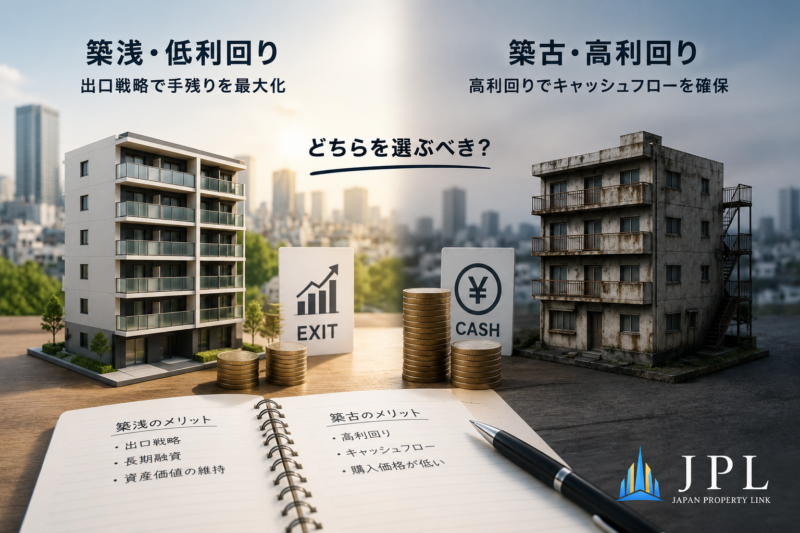
Successful investors don't necessarily only target properties that everyone wants. They also actively look at properties that appear to be in worse condition at first glance, such as vacant properties, older buildings, or properties with room for improvement in their management.
These properties tend to have less competition because many people are hesitant to invest due to perceived risks. However, if you can analyze why they are in that state and identify areas for improvement, those risks can become manageable.
In other words, the important thing is to create a state where you can "handle things because you understand them," rather than "avoiding them because they're scary." This difference in perspective becomes a major turning point between those who can win and those who cannot.
There's a world that can only be seen by looking beyond what has been piled up.
And another very important way of thinking is to build a track record in an area where you can gain an advantage, rather than trying to win in a fiercely competitive arena right away.
Even with properties that initially have relatively low competition, steadily building a track record will improve your standing with financial institutions, leading to better loan terms. Furthermore, as your experience in acquiring properties grows, your decision-making speed will increase, allowing you to make decisions the moment information becomes available.
It is precisely because of this accumulation that we can realistically approach properties with good estimates and well-arranged conditions that were previously out of reach.
In other words, by steadily building on areas where you can gain an advantage, you will eventually be in a position to compete even in a highly competitive market. I believe this is the shortest path to acquiring properties that offer good returns or are considered so-called high-quality properties.
Rather than immediately targeting properties that everyone is after from the start, gradually improve your position. Whether you can adopt this mindset significantly impacts long-term results.
Realistic strategies for successful real estate investment in Sapporo
Sapporo's real estate investment market is attractive to many investors due to the stability of demand and the predictability of rental needs depending on the area. On the other hand, precisely because of its stability, competition for "properties with good conditions" tends to be very fierce.
In order to achieve results, it is essential to have the perspective of "Can I acquire this property?" and "Can I win in this competitive environment?" rather than simply judging based on the good or bad of the conditions.
And it is never easy to make that judgment alone. How much is an acceptable risk, where is there room for improvement, and is this property a “winning property” for you? This discernment requires experience and an objective perspective.
That's why we focus on finding properties together that are not only attractively priced but also realistically attainable and likely to lead to success for our clients.
Instead of getting worn out in a fiercely competitive arena, I believe in steadily building up in areas where I have an advantage. From there, I aim for properties with better terms. Creating this flow realistically is the essential strategy for succeeding in real estate investment.
summary
The properties you perceive as good are also perceived as good by others. It is extremely important to have the perspective of "where you will compete" based on this fact.
Instead of fighting in a highly competitive space from the start, first build up a track record in an area where you can win. That accumulation of achievements will lead to the ability to acquire properties with better terms in the future.
Real estate investment is not a single event, but a business of accumulation. That's why where you make your first move greatly influences subsequent developments. Please try to be conscious of the idea of reliably accumulating in places where you can win.

Representative director
Success in real estate investment is not achieved by luck or coincidence. I believe that every encounter, decision, and outcome is inevitable for a reason. That's why I take responsibility for each and every project and believe in finding the best path forward with reliable information and strategy.