





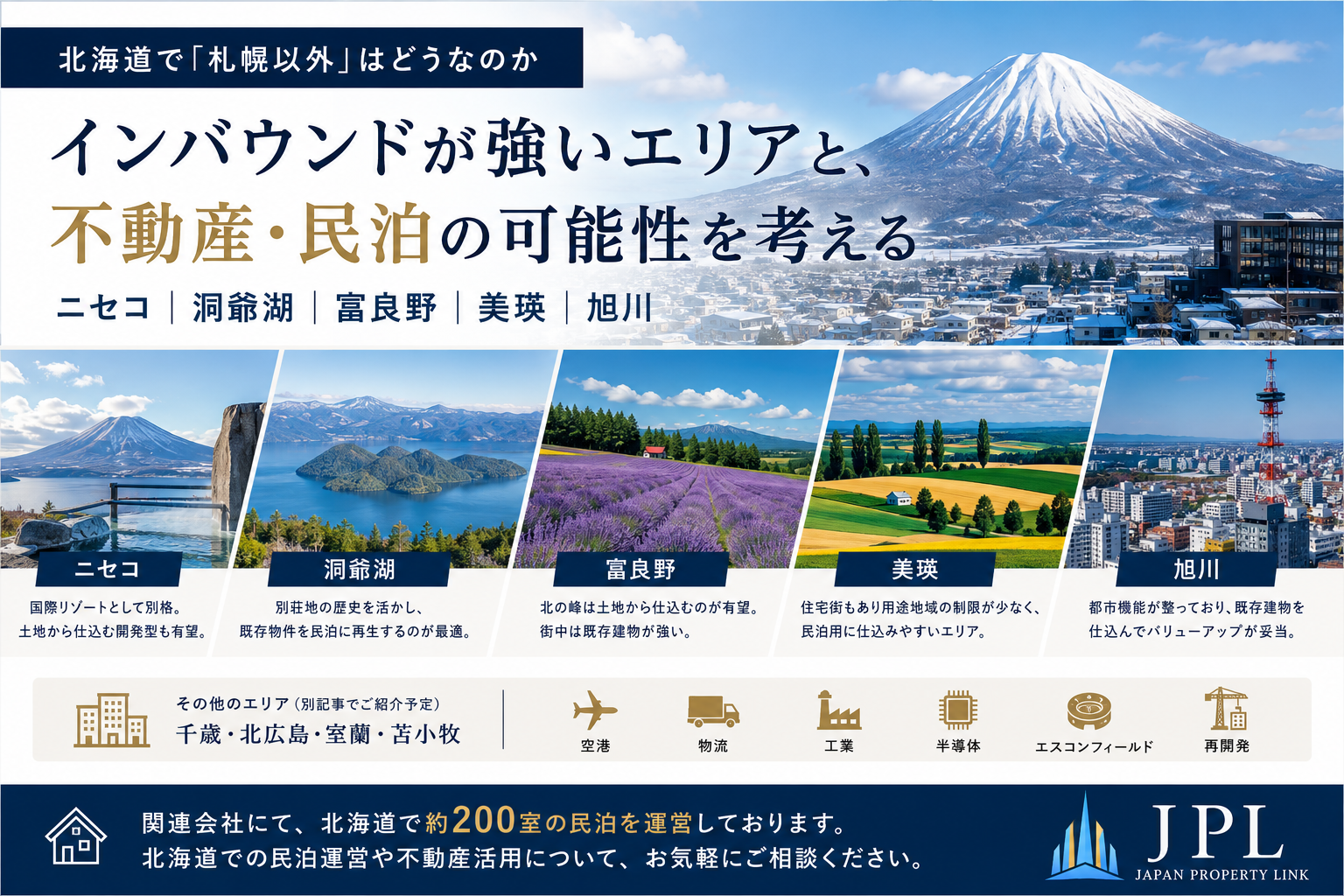
What's it like in Hokkaido "outside of Sapporo"? Considering areas strong with inbound tourism, and the potential for real estate and minpaku (private lodging).
2026.05.15
When you think of Hokkaido, the center is still Sapporo It is.
A large portion of the population, jobs, transportation, and commercial functions are concentrated in Sapporo, and Hokkaido's economic sphere is, for better or worse, built upon this "Sapporo-centric" structure.
However, in recent years, changes have begun to emerge in that structure.
Areas that are strongly attracting inbound demand are seeing particularly significant changes.
With the increase in overseas tourists, not just tourist destinations, but the regional economy itself, including "accommodation industry," "real estate investment," and "vacation rental operation," is undergoing changes.
This time,
- Niseko
- Lake Toya Town
- Furano
- Biei Town
- Asahikawa
This article will explore how "Hokkaido, strong in inbound tourism" is changing, and what strategies can be considered from the perspectives of real estate and minpaku (short-term rentals).
Also,
Chitose、Kitahiroshima、Muroran、Tomakomai Regarding this, it will be a separate story concerning airports, logistics, semiconductors, industry, and redevelopment, so we plan to compile it in a separate article.
Table of Contents
- Niseko has become exceptional as an "international resort."
- Lake Toya is a good match for "vacation home renovation" and minpaku.
- Furano's strategy changes depending on the area.
- Biei is a place where “residential homestays” can easily be established.
- Because Asahikawa is a “complete city,” its existing buildings are strong.
- "Hokkaido outside of Sapporo" is becoming quite interesting
Niseko has become exceptional as an "international resort."
Niseko This area is no longer just a regional tourist destination in Hokkaido, but is now spoken of as a "world-class snow resort."
When winter arrives, a large number of international tourists, primarily from Australia, flock to Japan, making English language support commonplace in restaurants and accommodations.
In some places, it even feels like English is more understood than Japanese.
Niseko's strength is, after all, its world-class powder snow.
The so-called “Japow” brand is established among international skiers and snowboarders and is recognized as a "must-visit snow resort."
As a result, the entire region has been restructured around tourism, including hotels, condominiums, villas, dining, and management companies.
From a real estate perspective, Niseko is naturally a strong area for existing buildings as well.
Since the demand for accommodation is already established, acquiring existing facilities with the assumption of occupancy and operating them while adding value is a viable approach.
However, what's even more interesting is the strategy of "cultivating from the land."
Considering that inbound demand will continue in the future, Niseko offers the potential for capital gains on the land itself, not just simple income.
I believe this is one of the few areas in Hokkaido where the concept of "considering the global market from the construction stage" is feasible, as it pairs exceptionally well with large villas and high-end vacation rentals specifically targeting wealthy individuals from overseas.
Of course, the initial investment will be substantial, but within Hokkaido, this is a region where “development-type” investments can be realized, which is unusual.
Lake Toya is a good match for "vacation home renovation" and minpaku.
Lake Toya Town It's not as flashy as Niseko.
However, it has carved out a unique position as a calm and luxurious tourist destination.
Lake, hot springs, natural scenery.
Overall, it is an area with a strong character as a "quiet tourist destination" and has excellent compatibility with foreign tourists.
What's interesting about Lake Toya is its history of development as a resort area.
In other words, there is a certain number of properties on the current market that were formerly villas.
And these properties are quite compatible with vacation rentals.
Especially around Lake Toya, the demand for “renting out an entire property to relax” rather than "staying at a hotel" is strong, making the strategy of renovating existing villas into accommodations very effective.
Personally, I think of Lake Toya as an area where it's more beneficial to utilize existing stock rather than building new homes from the ground up.
Because there is a past villa culture, it meshes with the current demand for vacation rentals.
This is quite distinctive even within Hokkaido.
Especially around hot spring resorts, properties that are "a little old but have atmosphere" tend to be well-received, and there's a strong impression that there's significant room for value enhancement through renovation.
Furano's strategy changes depending on the area.
Furano This is an area that cannot be generalized.
Their personalities change quite a bit, especially between "Kita no Mine" and "Machinaka."
First, regarding the North Peak area, it has a strong resort feel and is quite connected to overseas demand.
Therefore, I believe that "acquiring land first" is a strong real estate strategy.
Assuming inbound demand continues, there's potential to target both capital and income in Kitano Mine.
In other words,
- increase in land value itself
- Accrual of accommodation revenue
There is room to aim for both at the same time.
While the market size isn't as large as Niseko's, conversely, there's still room for growth.
On the other hand, downtown Furano has a slightly different character.
Since this also functions as a living area, it is more practical to acquire and operate an existing building.
In urban areas, it seems that operating guesthouses and simple accommodations, which leverage existing stock, makes it easier to plan finances because they can attract not only tourists but also those looking for medium to long-term stays or workations.
In other words, Furano is an area where the strategy changes significantly depending on "where you do it."
Biei is a place where “residential homestays” can easily be established.
Biei Town It's a place that embodies the Hokkaido brand itself.
Scenery of hills, vast sky, rural landscape.
From the perspective of overseas tourists, this is an area where "Hokkaido as they imagined it" truly exists.
And from a real estate perspective, Biei is quite unique.
It's a tourist destination, but there are also residential areas, and since there are relatively few restrictions on land use zoning, it's easy to acquire properties for short-term rentals.
This is quite a big point.
In popular tourist destinations, it's often difficult to build accommodation facilities as desired due to zoning restrictions and regulations related to the innkeeping industry.
However, there is relatively more room for flexible thinking in Biei.
Therefore, it is well-suited to the strategy of acquiring residential properties and converting them for lodging use.
Especially in Biei, the “scenery itself” is the content, so rather than luxurious commercial facilities, it's important to create a "stay experience that is truly Hokkaido."
In other words, I believe it's an area that has a higher affinity with the "rent the entire building" and "stay as if you're living there" approach, rather than a luxury hotel type.
Because Asahikawa is a “complete city,” its existing buildings are strong.
Asahikawa This one is a bit special among those listed.
It has more of the character of a "complete provincial city" than a tourist destination.
The population size is relatively large, and urban functions such as commerce, healthcare, and education are well-equipped.
Furthermore, it serves as a base for accessing Asahiyama Zoo and the Furano/Biei area, giving it tourist demand.
In other words, the balance between tourism and living infrastructure is very good.
Therefore, the real estate strategy in Asahikawa is relatively simple.
I believe that acquiring existing buildings and adding value to them is the most realistic approach, rather than land development.
Since the city is already complete, "how to improve existing stock" is more important than "building a city from scratch."
Especially in Asahikawa,
- Old hotel
- Old building
- Existing house
- Vacant property
Since a certain number of them also exist, there is room for regeneration through renovation.
Furthermore, as Asahikawa is also a hub city in northern Hokkaido, it is well-suited not only for simple tourist homestays but also for business trip and medium-term stay demand.
In that sense, it might be an area in Hokkaido that is relatively “easy to operate” and "predictable."
"Hokkaido outside of Sapporo" is becoming quite interesting
Hokkaido is still centered on Sapporo.
However, on the other hand, the individuality of each region, centered around inbound tourism, is becoming quite strong.
What's interesting is that the "optimal real estate strategy" varies completely by area.
There are places like Niseko where development-oriented land use is viable, and places like Lake Toya where revitalizing existing villas is strong.
Some areas, like Furano, require differentiated strategies for each region, while others, like Biei, are well-suited for residential homestays.
There are cities, like Asahikawa, where the value-up of existing buildings becomes the mainstream.
In other words, even saying "operating a minpaku in Hokkaido" can no longer be discussed as a single entity.
Finally, our affiliated company operates approximately 200 rooms of Airbnb accommodations within Hokkaido.
Through actual operations, we are accumulating daily data on demand, utilization, property selection, and operational challenges for each area.
If you are interested in operating a minpaku (private lodging) or utilizing real estate in Hokkaido, please feel free to contact us.
Representative director
Success in real estate investment is not achieved by luck or coincidence. I believe that every encounter, decision, and outcome is inevitable for a reason. That's why I take responsibility for each and every project and believe in finding the best path forward with reliable information and strategy.