


What's the Difference Between Retail Properties and Residential Properties? Merits and Risks to Consider for Real Estate Investment
When considering real estate investment, people often ask, "Which is better, commercial or residential properties?" "Residential" refers to properties for living, such as condominiums and apartments. "Commercial" refers to properties rented for business purposes, such as restaurants, beauty salons, retail stores, and offices. Both are income-generating properties, but they differ in terms of financing, reasons for tenant departure, repair costs, and vacancy periods. To get straight to the point, there is no single correct answer that applies to everyone. However, I prefer commercial properties. Today, I will explain why. The strengths of residential properties are their easy-to-understand demand and accessibility to financing. A place to live is necessary regardless of the economic climate. A major strength of residential properties is that rental demand is relatively easy to predict.
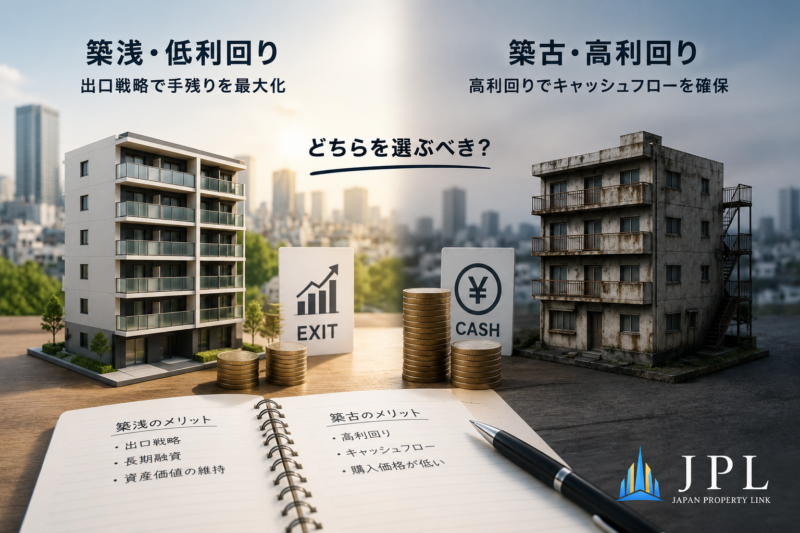
Newer property with low yield vs. older property with high yield: which should you choose in the end?
Are you choosing properties based solely on yield? "Should you buy a property that is newly built with a yield of around 6%, or a property that is over 30 years old with a yield exceeding 10%?" This is a question I often receive from those who are investing in real estate in Sapporo or are considering starting. To get straight to the point, I do not believe that "newly built is good" or "old is bad." Conversely, I also do not judge based on "high yield is good" or "low yield is bad." In fact, I myself sometimes purchase newly built properties and sometimes purchase older properties. What's important is how much profit the property can generate in the future. Real estate investment involves purchasing...

I can keep trying because I have a hobby.
First, everyone, do you have any hobbies? My hobbies are watching baseball, playing mahjong, and playing golf. As I'm from the Kansai region, I've been a Hanshin Tigers fan since I was little. When I was in elementary school, I joined their fan club and liked player Hamanaka. Even after moving to Hokkaido, I continued to watch baseball, but last year when I went to ES CON FIELD for the first time, I was truly astonished. To be honest, before I went, I just thought, "It's probably just a new stadium." However, when I actually went there, it far surpassed my imagination. The stadium's atmosphere, the completeness of its facilities, the abundance of restaurants, and most importantly, the ingenuity evident everywhere to make the baseball viewing experience itself enjoyable. While watching the game, I seriously thought, "I want to come here many times."

Are you looking for a property that perfectly matches your requirements? ~The idea isn't to find a 100-point property, but to nurture it to 100 points~
Introduction When discussing real estate investment in Sapporo with individuals considering or planning to purchase income-generating properties, we often hear the phrase, "There aren't many good properties available." It's true that compared to the past, selecting properties has become more challenging due to factors such as rising real estate prices and interest rate trends. However, upon closer examination of these conversations, we've noticed that it's not uncommon for people to be searching for properties that meet "100% of their criteria," rather than a lack of good properties. Real estate investment is by no means an inexpensive purchase, so we understand the desire to be cautious. However, excessive caution can lead to passing up opportunities on properties that would otherwise be a good investment.
2026.06.15

Is the introduced property really a good one? How to think about real estate investment without being swayed by off-market or under-the-table deals.
Introduction You might have heard these terms before if you're involved in real estate investment: "Off-market properties" "Under-the-radar deals" "Members-only properties" "Referral-only deals" Many investors likely feel a sense of exclusivity when they hear these phrases. In fact, when I speak with investors, I often receive inquiries like: "Do you have any off-market properties?" "I'd like you to introduce me to income-generating properties that aren't publicly advertised." It's true that properties not yet on the market seem to have fewer competitors, giving the impression that they can be purchased favorably. However, there's one thing I'd like everyone to consider calmly: Are referral-only or off-market properties truly good deals? …
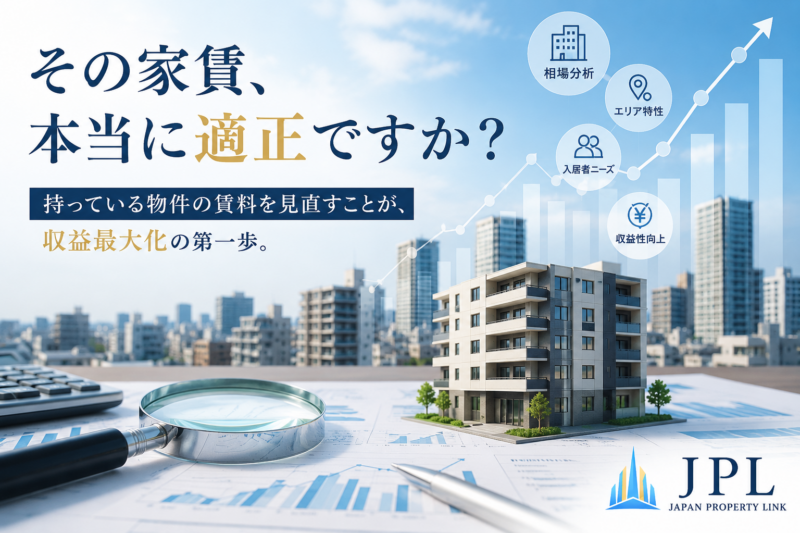
Is that rent really appropriate? Are you deciding the rent for your property based on a “hunch”?
When investing in real estate, many people focus on the “purchase.” What area is good? What about the yield? What are the financing terms? Will it appreciate in the future? Of course, these are all very important. However, what greatly affects actual profits is “post-purchase management.” Among these, "rent setting" is particularly important. If the current rent is too high compared to the market, it can lead to vacancy risk, and conversely, if it is too low, you may be missing out on profits that you could have otherwise earned. However, in reality, there are many cases where rent is set "vaguely" with reasons like: "This was the rent from the previous management company." "I've been renting it out for this amount for a long time." "It's currently occupied, so I haven't touched it."

Speed is number one
In the real estate industry, speed is the ultimate differentiator. This is something I often feel when working in the real estate industry: in the end, what separates the successful from the rest is “speed.” People with knowledge. People who are good at sales. People who speak eloquently. Of course, these are all important. However, when I observe people who are truly trusted by clients or who attract good deals, I see a common trait: they are people who “move fast.” Fast response. Fast confirmation. Fast decision-making. Fast action. Simply by doing these things, the flow of work truly changes. The world of investment real estate, in particular, is a speed race. Good properties simply disappear while you're pondering. That's why I've always believed, "First and foremost...
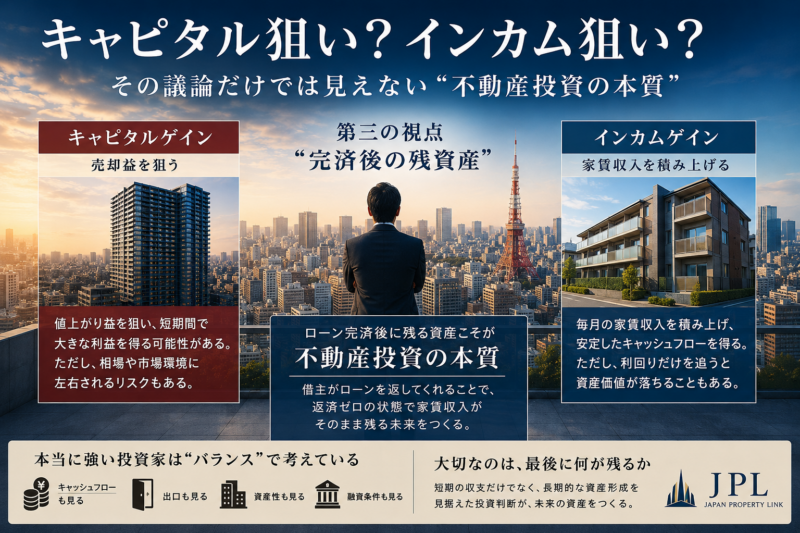
Aiming for capital gains? Or income? - The “Essence of Real Estate Investment” That Such Arguments Alone Can't Reveal”
When discussing real estate investment, the terms "Are you aiming for capital gains?" and "Are you aiming for income?" almost always come up. Are you aiming for profit from price appreciation? Or are you accumulating monthly rental income? Real estate investment is a world often discussed in these two options. Of course, this way of thinking is not wrong. However, after being in the real estate industry for a long time, you realize that there are many investors who cannot be explained by these two options alone. Rather, those who truly build wealth tend to not divide themselves so simply into "I am a capital gains investor" or "I am an income investor." This time, we will discuss "capital gains," "income," and multiple other aspects of real estate investment...
2026.05.18
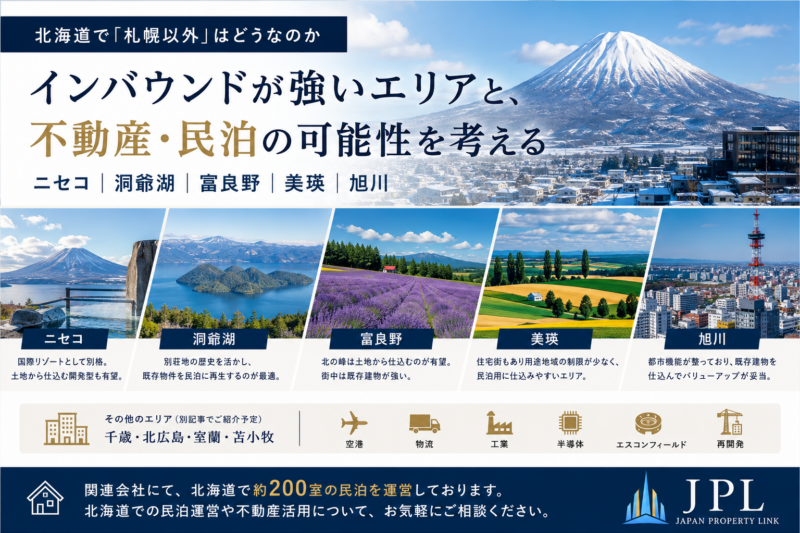
What's it like in Hokkaido "outside of Sapporo"? Considering areas strong with inbound tourism, and the potential for real estate and minpaku (private lodging).
When you think of Hokkaido, Sapporo is indeed the center. A large portion of the population, jobs, transportation, and commercial functions are concentrated in Sapporo, and Hokkaido's economic sphere, for better or worse, is built on this "Sapporo-centric" structure. However, in recent years, changes have begun to emerge in this structure. The areas that are strongly capturing inbound demand have seen particularly significant changes. The increase in foreign tourists has not only turned them into mere tourist destinations but has also transformed the regional economy itself, including the "accommodation industry," "real estate investment," and "minpaku (homestay) operations." This time, focusing on Niseko, Toyako Town, Furano, Biei Town, and Asahikawa, we will explore how "Hokkaido with strong inbound demand" is changing and what strategies can be considered from the perspective of real estate and minpaku.
2026.05.15