




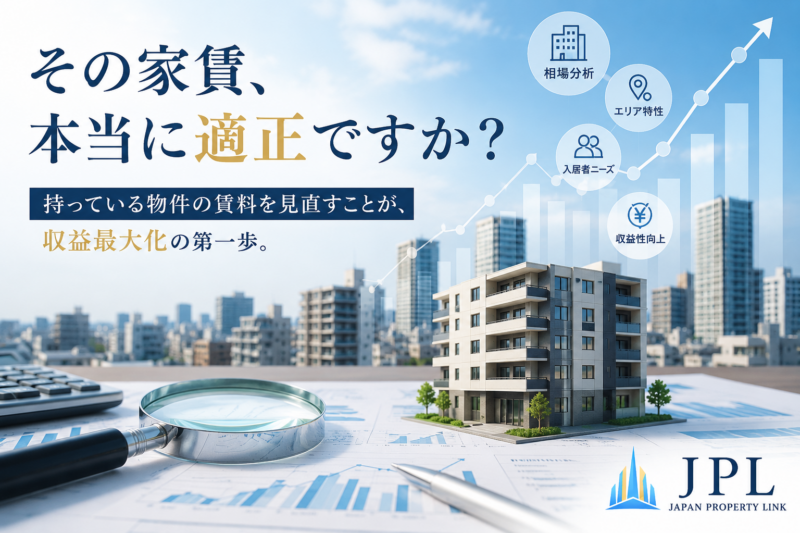

Is that rent really appropriate? Are you deciding the rent for your property based on a “hunch”?
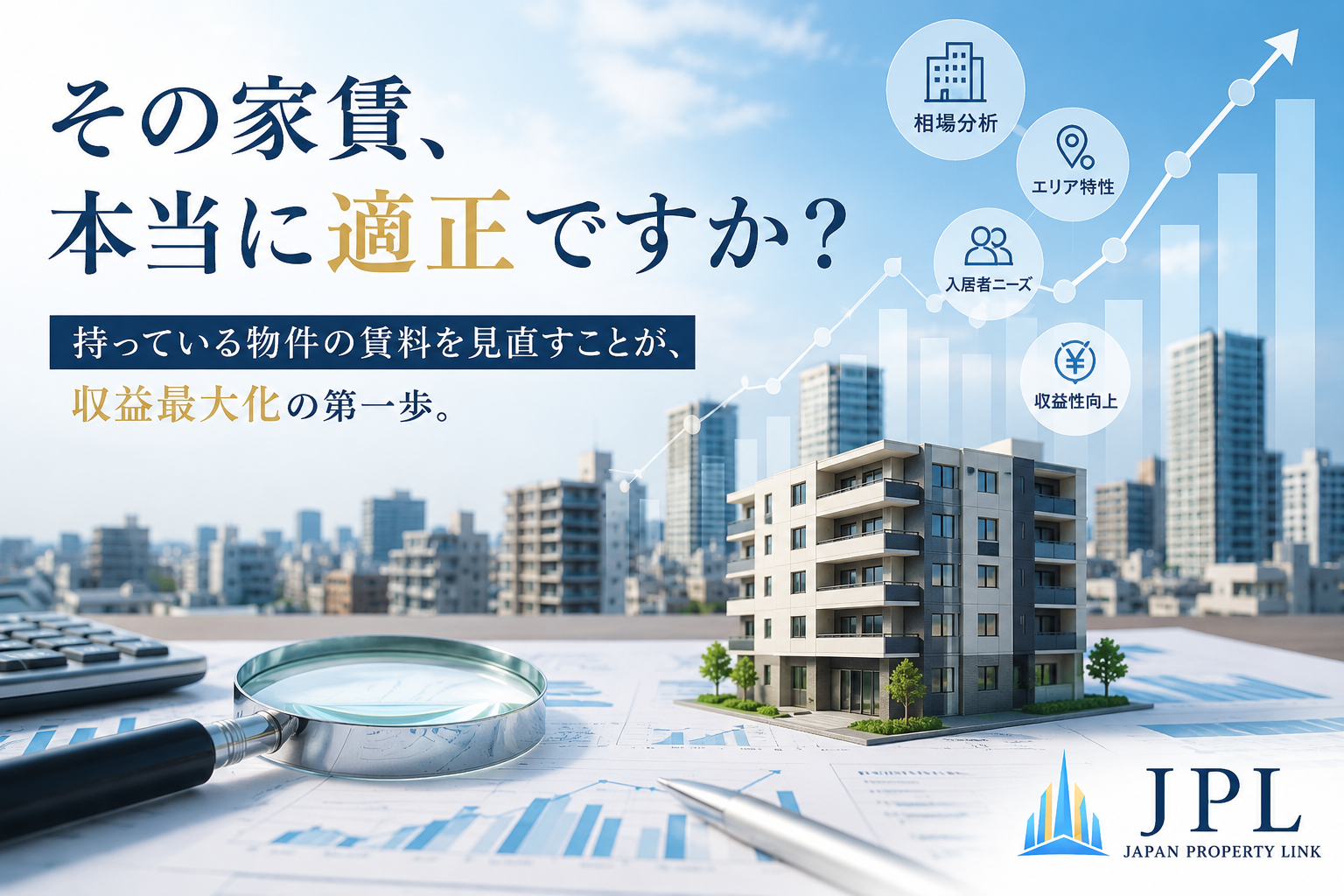
In real estate investment, many people focus on the "purchase" phase.
Which area is good?
What about the yield?
What are the financing terms?
Will the price increase in the future?
Of course, these are very important.
However, what greatly influences actual revenue is “post-purchase operations.”
Among these, "rent setting" is particularly important.
If your current rent is too high compared to the market rate, it can lead to vacancy risk. Conversely, if it's too low, you might be missing out on potential revenue.
However, in reality,
Because that was the rent with the previous management company.
"I've been lending it at this amount for a long time."
It's currently occupied, so I haven't touched it.
It feels like in many cases, rent is set somewhat arbitrarily.
However, the rental market is always changing.
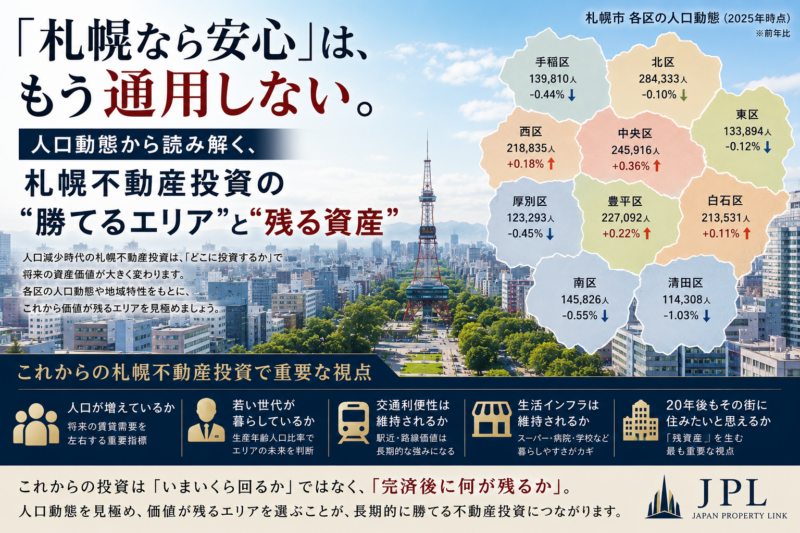
Especially within Sapporo city, the differences between areas and the movement of rent ranges have become considerably larger than before.
That's why, once again,
Is the rent for my property truly appropriate?
It is becoming very important to review.
Table of Contents
- "Continuing to rent at a low price" is scarier than having vacancies.
- In reality, how do you think about rent appraisal?
- You can't understand the market just by looking at the internet.
- Even within Sapporo, areas are completely different.
- Full occupancy does not equal success.
- Raising rent is not inherently a bad thing.
- Please review your property's rent price once.
"Continuing to rent at a low price" is scarier than having vacancies.
Some owners
"If it means we'll have vacancies, I'd rather rent it out for a little less."
Some people hold this view.
Of course, the way of thinking itself is not necessarily wrong.
However, in reality, the state of “continuing to rent cheaply” has a greater impact on revenue than you might imagine.
For example, if you rented it out for 5,000 yen cheaper per room.
If there are 10 rooms, that’s a difference of 50,000 yen per month, or 600,000 yen per year.
If it continues for 10 years, that's 6 million yen.
Moreover, since real estate prices are often viewed by income capitalization, low rental income also affects the selling price.
In other words, not being able to charge the appropriate rent means that
Not just monthly revenue, but
This is also affecting the asset value itself.
If you overlook this, there are many cases where it leads to significant losses without you even realizing it.
In reality, how do you think about rent appraisal?
In fact, when I myself purchase an income property at my company, I always estimate the rent.
Naturally
This should be enough.
I wouldn't make a purchase decision based solely on that feeling.
Rather, I'm looking at rent setting quite carefully.
Within that, our company is assuming three main patterns for rent.
The first one is,
Rent that is sure to be rented at this price.
The second is,
Rent based on the current market conditions, which we estimate to be around this much.
And the third is,
This is a challenging price that might be achievable depending on the equipment, market conditions, and timing of the offering.
In other words, you make investment decisions after confirming the “safety line” from the very beginning.
So, when we actually put out the recruitment notice,
Rent may be decided at a higher price than expected.
Conversely,
"With this rent, it should be rented out quickly."
It rarely falls below the line I was considering.
If such cases are occurring frequently, it might be a bit harsh to say, but there's a possibility that the initial investment decision itself was flawed.
This is because real estate investment isn't something where you make a profit “after you buy,” but rather, the outcome is largely determined at the point of “purchase.”
The rent assessment at the time of purchase was too lenient.
I can't see the market conditions nearby.
I don't have a grasp on the competitive properties.
I don't understand the area demand.
If you purchase it in this condition, it won't be easy to fix it later through operational efforts alone.
That's why, not just the property price, but
"Can you really manage with that rent?"
I believe that calmly analyzing [something] is very important in real estate investment.
You can't understand the market just by looking at the internet.
Nowadays, with platforms like SUUMO and HOME'S, it's easy to look up rental market prices.
However, in actual practice, there are many things you can't understand just by looking at a portal site.
For example,
Is the rent really finalized at that price?
Has it been vacant for a long time?
Are they paying for advertising?
Is a free rent period being offered?
How long has it been since recruitment started?
We can't see these kinds of “behind-the-scenes” aspects.
In other words, just looking at the advertised rent on the surface,
"Is this about the extent of this area?"
It is dangerous to conclude that.
In reality,
Some properties are listed at high prices but have not been rented out at all.
Conversely, there are also properties that receive applications even before they are advertised.
That's why, for a true rent appraisal,
Regional demand
Competing properties
Facility status
Managed state
Target audience
Seasonal factors
You need to look at these comprehensively.
Even within Sapporo, areas are completely different.
When people talk about Sapporo, they often generalize, but in reality, rental demand varies quite a bit from area to area.
Some areas have strong demand from single people in the central district, while others have strong demand from families in the suburbs.
More recently,
・Within walking distance of the subway?
・Availability of parking
Internet connection
・Year built
Competition with the Minpaku (private lodging) area
The resonance also changes greatly depending on various factors.
In other words,
"Because the local market rate is \x{25A1}ten thousand yen."
The era has arrived where you can no longer determine fair rent based solely on such a simple way of thinking.
In particular, within Sapporo city, areas are moving quite differently due to redevelopment and the recovery of inbound tourism.
If you keep setting rents based on how things felt a few years ago, it's not uncommon to find yourself out of sync with the market without realizing it.
Full occupancy does not equal success.
When investing in real estate,
"It's fully occupied, so we're safe."
There are no vacancies, so there's no problem.
Many people will also think so.
Of course, a low vacancy rate is a good thing in itself.
However, I'd like you to consider this for a moment:
“Is that full occupancy really due to appropriate rent levels?”
is the point.
For example, if the rent is set significantly lower than the surrounding market rate, it's natural for it to be fully occupied, in a sense.
However, this may be cutting into potential revenue.
Actually, when I talk with the owner,
"I was relieved because it was always full."
Even for those types of people, it's not uncommon for them to rent out properties for several thousand yen cheaper compared to the surrounding market prices.
This trend becomes more pronounced in properties with a higher proportion of long-term residents.
Of course, it is very good that you can live here for a long time.
On the other hand, the market has definitely changed from a few years ago.
Soaring construction costs.
Price increase.
Increase in management fees and repair costs.
Internet equipment standardization.
With this background in mind, the overall way of thinking about the rental market is also changing.
That's why, instead of saying "It's okay because it's full now,"
“Is it appropriate given the current market?”
It is important to check regularly.
Real estate investment doesn't end with the purchase.
The final outcome will vary significantly depending on how much you can maximize your profits during the holding period.
To achieve that, I believe a perspective of not just maintaining the status quo, but also appropriately adjusting rents while monitoring the market, will become increasingly important from now on.
Raising rent is not inherently a bad thing.
Some people have a negative image of the term "wage increase."
However, revising to appropriate rent is by no means a bad thing.
For example,
Clearly cheaper than the surrounding market price
Adding equipment.
Improving management status
Property taxes and maintenance costs are increasing.
In such a situation, it's only natural to consider a rent review.
Of course, an unreasonable price increase would be counterproductive.
However, adjusting to an appropriate rent can often lead to improved revenue.
Especially for owners who are considering long-term holding, this small difference will become a big difference in the future.
Please review your property's rent price once.
Real estate investment results can vary greatly not only at the time of purchase but also through operational management during the holding period.
And among those, "rent" is a very important point that directly relates to revenue.
Is the current rent truly appropriate?
Isn't the price too high, and isn't there a risk of vacancies?
Conversely, by continuing to rent at a low price, aren't you missing out on revenue?
Even a single review can lead to future profit improvements.
We also offer rental price assessments based on market trends and competitor information, primarily within Sapporo city.
We also handle inquiries regarding rent increase negotiations for currently occupied rooms, so please feel free to ask.

Representative director
Success in real estate investment is not achieved by luck or coincidence. I believe that every encounter, decision, and outcome is inevitable for a reason. That's why I take responsibility for each and every project and believe in finding the best path forward with reliable information and strategy.