

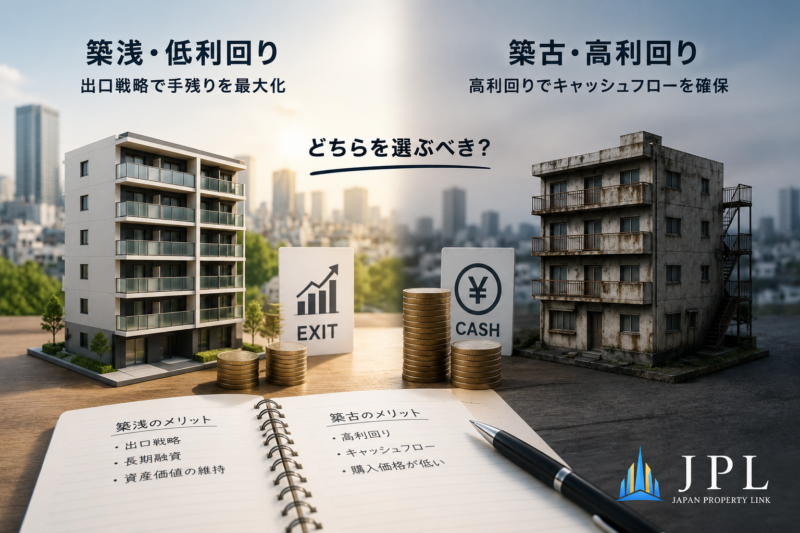




Newer property with low yield vs. older property with high yield: which should you choose in the end?
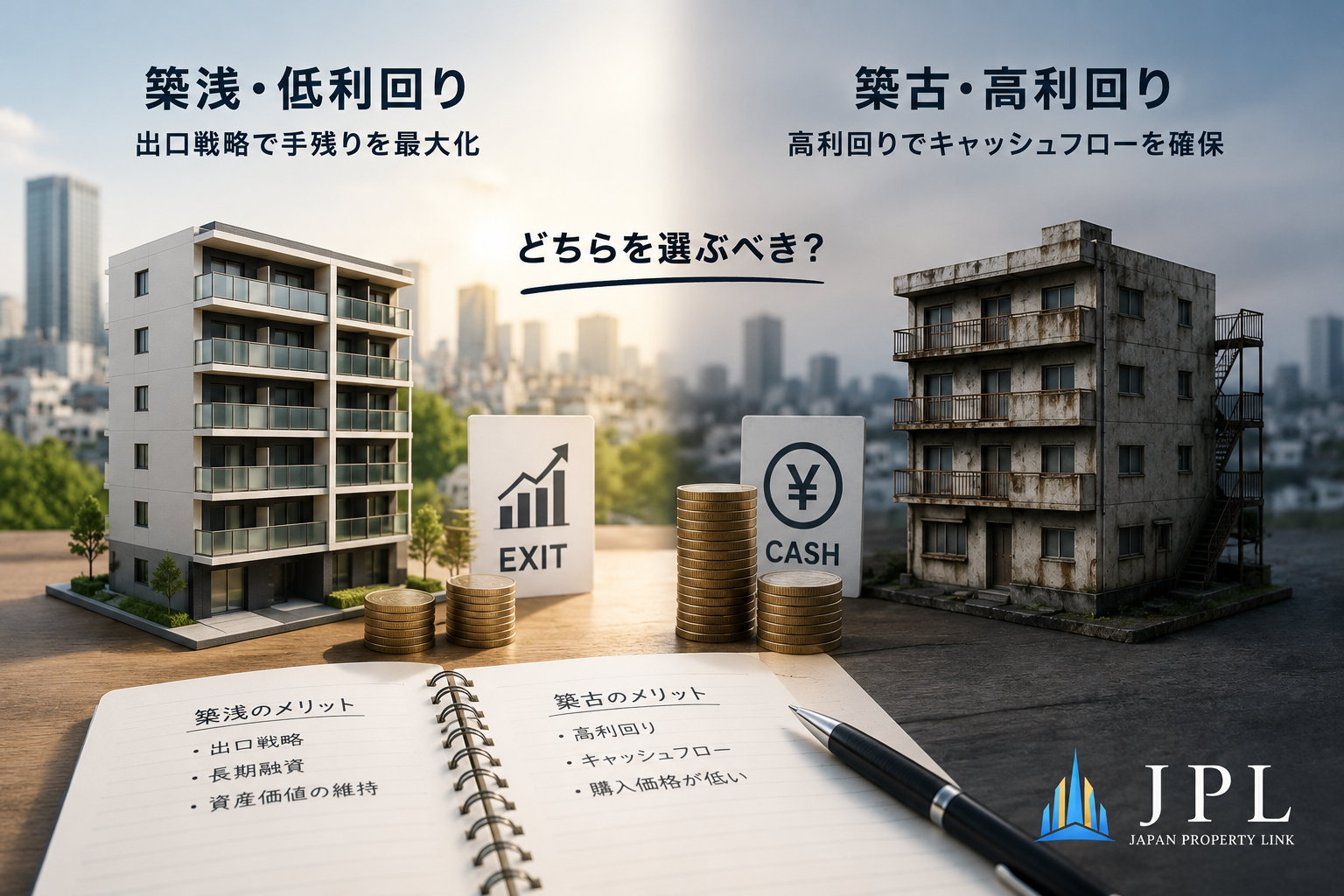
Table of Contents
- Are you choosing properties based on yield alone?
- The biggest appeal of a recently built property with a low yield is the "exit strategy."
- The ability to secure long-term loans is also a significant advantage.
- Newer homes obviously have disadvantages too.
- Older buildings with high yields are attractive for cash flow.
- When buying an older property, a key point to be aware of is financing conditions.
- How should one think about properties that are old but have low yields?
- Things that are important for successful real estate investment in Sapporo

Are you choosing properties based on yield alone?
Should I buy a property that's recently built with a yield of around 6%, or a property over 30 years old with a yield exceeding 10%?
I often receive this question from people who are investing in real estate in Sapporo or are thinking about starting.
To get straight to the point, I don't believe that "new is good" or "old is bad."
Conversely, we don't judge that "high yield is good" or "low yield is bad."
I myself sometimes purchase newly built properties and sometimes purchase older properties.
What's important is how much profit the property can generate in the future.
Real estate investment is not about the moment you purchase it.
I believe that truly successful real estate investment involves managing properties, earning rental income, and ultimately profiting from the sale.
Therefore, it's a great shame to make a decision based solely on the age of the building and the gross yield.
This time, I'd like to share my thoughts on the merits and demerits of newly built low-yield properties versus older, high-yield properties, which may be helpful for those investing in real estate in Sapporo.
The biggest appeal of a recently built property with a low yield is the "exit strategy."
The funds remaining in hand tend to be larger when sold.
Some people say they don't buy newly built properties because the yield is low.
Of course, just looking at the numbers, it might seem like rental yields are often lower than for older properties.
However, the reason I value new construction is not for the yield.
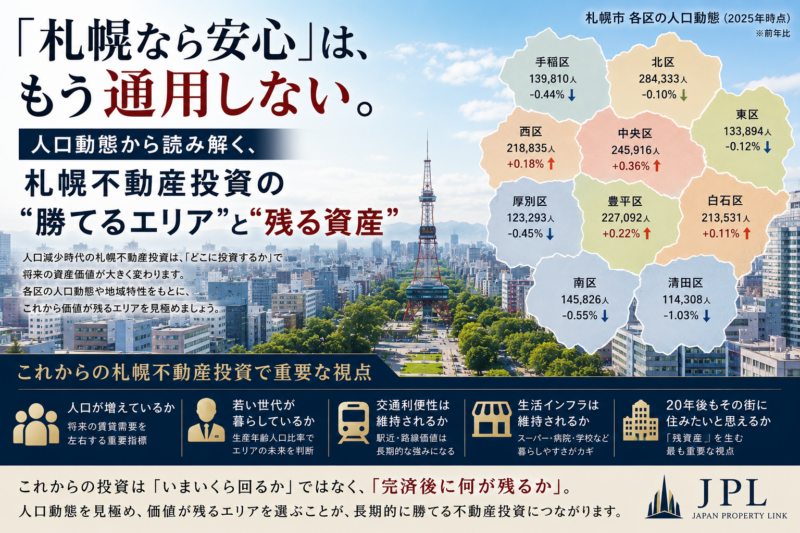
The biggest draw is the exit strategy. Of course, there are other benefits like being easy to rent out and low maintenance costs, but the primary attraction for me is this.
Properties that are recently built tend to maintain their value relatively well and are favorably assessed by financial institutions, making it easier for buyers to utilize loans when purchasing them.
This means it's easy to sell when you decide to sell.
Furthermore, if the balance between the purchase price and remaining debt is favorable, there's a possibility of having a substantial amount of cash left on hand upon sale.
This funding can be used as a down payment for the next investment, allowing you to increase your assets with a second and third property.
In real estate investing, I believe the most important thing isn't just "how much rent comes in," but rather "how much is ultimately left in your pocket."
That's why newly built properties, which are easy to plan an exit strategy for, are so attractive.
The ability to secure long-term loans is also a significant advantage.
Easy to maintain a comfortable cash flow
Newer properties are highly valued by financial institutions, and often qualify for long-term loans.
If the financing period is extended, the monthly repayment amount can be reduced.
As a result, even if the surface yield isn't high, there can be ample monthly cash flow.
"Newly built properties have low yields, so they're not profitable."
People tend to think that way, but in reality, you can't see the true profit and loss without considering the loan terms.
Cash flow is not solely determined by yield; loan term and interest rate also have a significant impact.
It's important to look at the entire financial plan rather than just focusing on the numbers.
Newer homes obviously have disadvantages too.
Borrowing for a long time means paying more interest.
While newly built properties allow for longer loan terms, this also means paying interest to the financial institution for a longer period, resulting in a larger total interest amount.
Also, because property prices are often high, even a slight fluctuation in interest rates can have a significant impact on the total repayment amount.
Lately, there's been more talk about rising interest rates.
That's why, instead of thinking "I can borrow for a long time, so it's safe," it's important to create a repayment plan that looks ahead to the future.
Older buildings with high yields are attractive for cash flow.
If you prioritize monthly income, this is very interesting.
On the other hand, the appeal of older properties is undeniably their high yield.
Because the purchase price is kept low, the profitability against monthly rental income tends to be high, making it very attractive to investors who prioritize cash flow.
Of course, I myself also purchase older properties.
It's not just because the property is old that we're buying it.
I purchase when I determine that the price is appropriate, there is demand in the area, and a profit can be made, including the renovation plan.
I think it's a real shame to shy away from something just because it's old.
When buying an older property, a key point to be aware of is financing conditions.
There are also many cases where you'll need your own funds.
Financing for older buildings may have a shorter loan term from financial institutions.
That will increase the monthly repayment amount.
Even if the gross yield is high, the repayment burden can become heavy, and you might not have as much cash flow left as you expected.
Additionally, unlike newly built properties, there are fewer cases where you can purchase with a full loan, and you may be asked to provide a down payment.
In other words, even if the property price is low, there are cases where the down payment you need to prepare initially can be surprisingly large.
For those looking to expand their investments, this difference is by no means small.
How should one think about properties that are old but have low yields?
It's best to be cautious and make a careful judgment.
I sometimes see properties that are old but have low yields.
To be honest, unless there are clear reasons such as an excellent location or potential for future redevelopment, I generally believe it's better to proceed with caution.
Since the building is old, there is a possibility that repair costs will be incurred in the future.
Moreover, if the yield is also low, the appeal as an investment is inevitably diminished.
However, there's one thing I'd like to tell you here.
As I've said many times on this blog, what I've discussed so farIntending to rent it outThis is the way of thinking I've adopted.
While conditions like zoning are certainly a factor, even older, low-yield properties can be transformed into high-yield properties by changing their utilization methods.
That isConvert to short-term rentalIt is.
Some of you might be thinking, "Here we go again with the minpaku talk" (lol).
However, this is something I've actually experienced.
We have transformed properties that would have been difficult to sell or did not yield profitable returns into highly profitable ones by purchasing properties not only in Sapporo but also across various locations in Hokkaido, such as Furano and Lake Toya, and by incorporating the option of minpaku (short-term rentals) in addition to long-term rentals.
A property's value changes significantly not only based on "what you buy" but also on "how you use it."
That's why I don't judge a property's value based solely on its rental income potential.
Things that are important for successful real estate investment in Sapporo
Judge by whether it's profitable, not by its age.
In the end, there's no right answer to the debate of whether new or old is better.
I know this is a bit of a sneaky thing to say after you've read this far, but it's true that every property has its pros and cons.
Therefore, based on my experience, I assess whether a property can be further developed and then purchase it.
This time, I've been talking about Sapporo specifically, but we also purchase properties not only in Sapporo but also in Furano, Lake Toya, Niseko, Asahikawa, and other locations.
What's important is whether the property will leave a profit in the future.
Even if it's newly built, you'll fail if you buy it at a high price.
Even with older buildings, you can achieve great success if you purchase them at a fair price and have a plan for management and exit strategy.
Furthermore, even properties that are not profitable from rentals alone can see their value significantly change through short-term rentals or other uses.
If you're worried about whether you should buy this property, struggling to sell a property you want to sell, or wondering how to increase your yield, please consult us.
No matter how small it is.
Based on my extensive experience viewing numerous properties, I may be able to propose suitable utilization methods and exit strategies for the property.
Real estate investment cannot be solely defined by numbers like building age and yield.
That's why I want to continue to be involved in real estate investment in Hokkaido and Sapporo, while considering the optimal approach for each individual property.

Representative director
Success in real estate investment is not achieved by luck or coincidence. I believe that every encounter, decision, and outcome is inevitable for a reason. That's why I take responsibility for each and every project and believe in finding the best path forward with reliable information and strategy.