







This is almost certainly why vacancies aren't being filled [Sapporo Vacancy Solutions]
2026.04.13
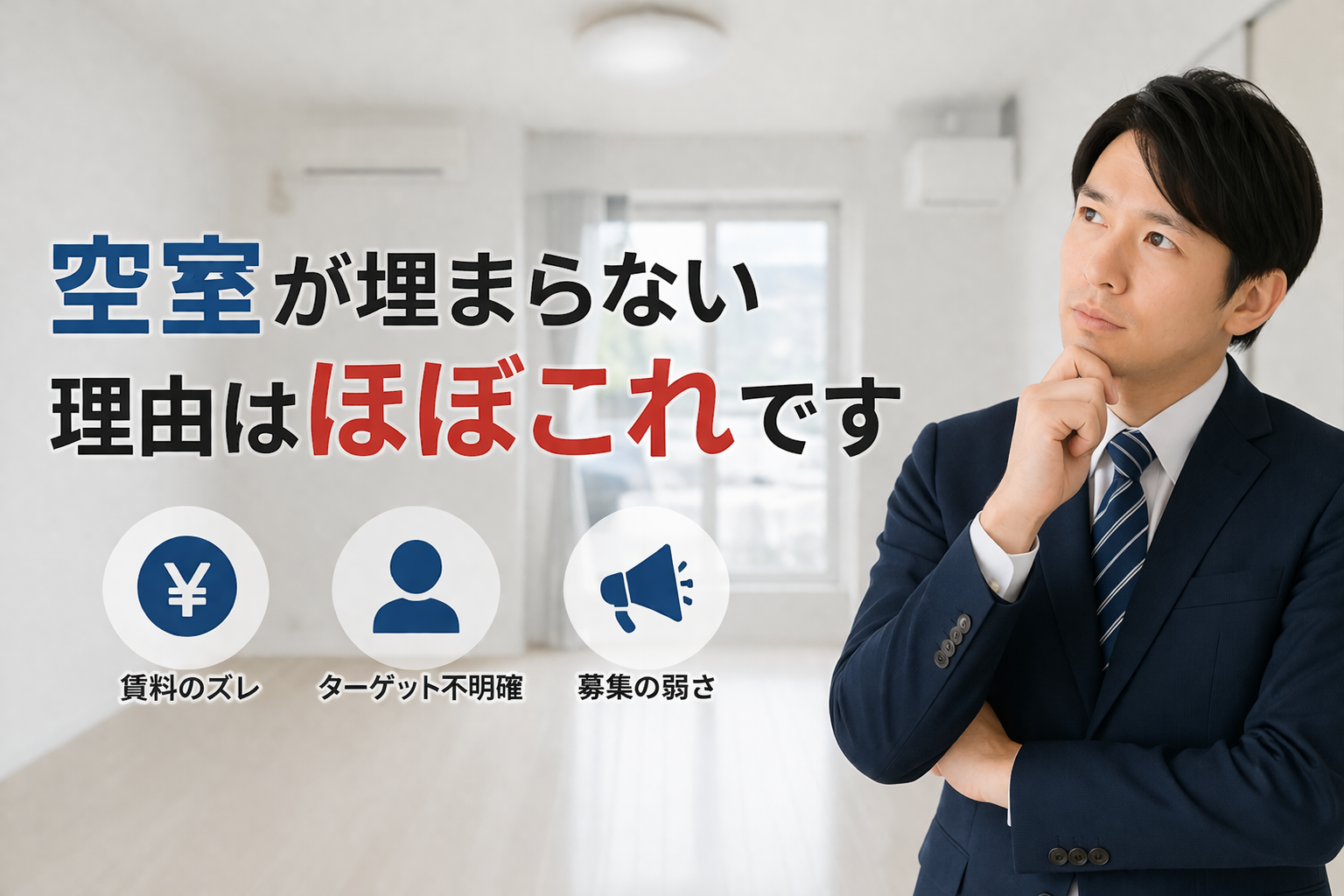
Table of Contents
- Understand correctly why vacancies are not being filled in Sapporo
- Critical problems caused by misalignment in rent settings
- “Properties that aren't chosen due to a lack of target audience”
- The quality of recruitment drives the response in this era.
- The vicious cycle caused by incorrect vacancy countermeasures
- Recruitment that ignores area characteristics will fail.
- If you leave it up to the management company, vacancies won't be filled.
- Specific Strategies for Improving Vacancy Rates in Sapporo Rental Properties
- Vacancies can always be improved with analysis.
- Conclusion: The reason vacancies aren't filling is simple

Understand correctly why vacancies are not being filled in Sapporo
Many people searching for "Sapporo Vacancy Measures," "Reasons Why Vacancies Aren't Filling," and "Improving Rental Vacancies" are likely experiencing long-term vacancies and are unsure of what improvements to make. To put it simply, the reason vacancies aren't filling is straightforward, yet often overlooked in many cases. It's that the market and the property conditions don't match.
The important point here is not that "the property is bad." In reality, many properties have the potential to be rented out if marketed properly, the issue is simply that their terms aren't set appropriately for the area, age, and amenities. Sapporo's rental market has a clear supply and demand balance by area, and any miscalculation in setting terms directly leads to vacancies.
In other words, the reason vacancies aren't filled isn't by chance, but by near necessity. And structurally understanding this necessity is the first step to improving rental vacancies.
Critical problems caused by misalignment in rent settings
The most common reason for vacancies is a rent price mismatch. In Sapporo's rental market, prospective tenants compare multiple properties simultaneously on portal sites. Even a difference of a few thousand yen can easily lead to a property being excluded from consideration.
Many owners try to maintain rents based on past successful transactions or by working backward from the purchase yield. However, the market is constantly changing, and the appropriate rent will vary even under the same conditions due to an increase in competing properties or advancements in facilities. If you are unable to keep up with these changes, the root cause of "vacancies that are difficult to fill" lies here.
The important thing isn't simply lowering the rent, but whether the price falls into a range that is chosen in the current market. For vacancy countermeasures in Sapporo, strategic rent setting based on the closing status of competing properties is essential.
“Properties that aren't chosen due to a lack of target audience”
In improving vacant rental properties, target market design is as important as rent. Properties where the intended tenants are unclear will ultimately fail to resonate with anyone.
For example, the necessary facilities and selling points change greatly depending on whether you are targeting single people, families, or international tenants. Despite this, there are many cases where recruitment is carried out without clearly defining the target.
In Sapporo's rental market, there are multiple demands, including student demand, relocation demand, and short-term stay needs due to the recovery of inbound tourism. If you recruit without deciding which segment to target, you will end up with a "featureless property" that gets lost in the crowd.
The reason vacant rooms aren't being filled isn't simply that the conditions are bad, but that it's not being communicated who the property is for.
The quality of recruitment drives the response in this era.
Another often overlooked point is the quality of the recruitment. From the perspective of vacancy countermeasures in Sapporo, it is not uncommon for responses to change significantly just by improving this.
Current tenants first decide whether to view a property based solely on the photos and information on property portals. Therefore, if the quality of the photos or the amount of information is insufficient, it can lead to a loss of opportunity. Even if a property is actually good, if its appeal is not communicated, it will be treated as if it doesn't exist.
Furthermore, there are many cases where the strengths of a property are not clearly articulated. Even though there are elements that could be leveraged, such as distance from the station, surrounding environment, sunlight, or features of the facilities, they are not properly communicated, leading to a loss against competitors.
One of the reasons vacancies remain unfilled is this "weakness in presentation," which accounts for a very large portion of the problem.
The vicious cycle caused by incorrect vacancy countermeasures
When vacancies continue, many owners tend to resort to stopgap measures out of impatience. A prime example of this is the decision to lower the rent, just to do something. While this measure may seem rational at first glance, it does not actually provide a fundamental solution.
This is because even if you lower the rent, if the target audience or recruitment issues are not resolved, you will still not be chosen. Furthermore, once you lower the rent, it becomes difficult to raise it again, posing a risk of significantly impairing long-term profitability.
When addressing vacancy issues in Sapporo, the key is not to engage in price competition, but to establish the right positioning. To achieve this, it's necessary to objectively analyze the property's standing and clearly define which demographic to target and how to approach them.
Recruitment that ignores area characteristics will fail.
A common oversight in vacancy prevention in Sapporo is the lack of strategies that consider the characteristics of each area. Even within Sapporo, tenant needs differ significantly between areas like Chuo Ward and Higashi Ward, or between suburban areas. Ignoring these differences and advertising with uniform conditions is essentially creating your own reason for vacancies remaining unfilled.
For example, in Chuo Ward, the focus is on single professionals and corporate contracts who prioritize convenience. Therefore, even if the rent is slightly higher, properties with superior facilities or location will be chosen. On the other hand, in suburban areas, the balance between rent and space is viewed more critically, and cost performance is emphasized. Despite these market assumptions, if the property conditions are not aligned with the area's characteristics, the "reasons for vacancy not being filled" become very clear.
Furthermore, the seasonality specific to Sapporo cannot be ignored. While demand for moving decreases in winter, it concentrates in early spring. Whether or not recruitment conditions and advertising are reinforced to match this timing also greatly affects the improvement of rental vacancies. Simply following the same pattern throughout the year leads to missed opportunities.
If you leave it up to the management company, vacancies won't be filled.
Another important perspective is the reliance on management companies. Of course, management companies play a significant role, but if you completely delegate vacancy countermeasures to them, you often see situations where improvement stalls.
Because property management companies handle multiple properties simultaneously, it can be difficult to develop in-depth strategies for each individual property. As a result, they may be limited to general listing conditions and templated advertisements, potentially missing out on responses that they could otherwise attract.
If you're serious about addressing vacancies in Sapporo, owners themselves need to grasp the current situation and independently make decisions regarding rent, target tenants, and recruitment methods. In reality, many reasons for vacancies remaining unfilled stem from a state where "no one is seriously optimizing."
While strengthening collaboration with management companies, it's important to have a strategy for each property. Whether or not this awareness exists can significantly change the results of rental vacancy improvements.
Specific Strategies for Improving Vacancy Rates in Sapporo Rental Properties
To improve rental vacancy rates, it's important to review rent, target demographics, and marketing strategies as an integrated whole. While these three elements may seem independent, they are actually closely related.
For example, if you set the target as a single working adult, the presence or absence of facilities such as free internet and a delivery box becomes important, and the appropriate rent will naturally be determined. Conversely, for students, flexibility in initial costs is often emphasized while keeping rent down.
In this way, optimizing rent and presentation according to the target is the essential approach to vacancy counter-measures in Sapporo. Results can only be achieved by reviewing the entire plan, not by individual improvements.
Vacancies can always be improved with analysis.
As I've explained, the reasons for the vacancies are far from accidental. The combination of three factors—rent discrepancies, absence of target tenants, and weak advertising—has resulted in prolonged vacancies.
Conversely, by breaking these down one by one and adjusting them correctly, vacancies can be improved with a high probability. The important thing is to make decisions based on data and the market, not on intuition.
The Sapporo rental market will continue to change, but its fundamental structure will remain the same. If you keep in mind the principle of optimizing conditions to match the market, stable operations will be possible in any environment.
Conclusion: The reason vacancies aren't filling is simple
The reasons why vacancies remain unfilled may seem complicated, but they are actually very simple. It's a disconnect with the market. If this disconnect is left unaddressed, vacancies will persist; if it's corrected properly, the situation will improve.
To combat vacancies in Sapporo, it's not about lowering rent or blindly advertising. It's about accurately assessing the property's position and optimizing it for the target audience.
Just by having this perspective, the "reasons why vacancies aren't being filled" become clear, and the path to "improving rental vacancies" also becomes visible. Vacancies always have a cause, and if you face those causes correctly, they can always be resolved.

Representative director
Success in real estate investment is not achieved by luck or coincidence. I believe that every encounter, decision, and outcome is inevitable for a reason. That's why I take responsibility for each and every project and believe in finding the best path forward with reliable information and strategy.